Pages

Showing posts with label software. Show all posts

Tuesday, August 7, 2012

Nuance Nina to put Siri into any app

Nuance has announced the availability of a software-development kit (SDK) for a new voice-recognition software that it's calling Nina, offering developers the opportunity to incorporate Siri-like natural language recognition into any app for iOS and Android.

To be clear, Nina itself isn't an app for users to download. Instead, it is a collection of APIs bundled together into an SDK that can be licensed by application developers for use in the apps they are working on. The SDK includes natural speech-recognition capabilities, so that users can navigate tasks within an application by using common, everyday phrases. Deciphering speech takes place in the cloud on Nuance servers before delivering results back to the application over the air.
The Nina SDK also incorporates voice biometric security that Nuance has been developing, which can be used in place of typed passwords for applications requiring high levels of security, including banking apps. In apps that don't require passwords, the same voice biometrics can be used to identify who is speaking. A multiplayer game using voice could be played without passing a handset back and forth, for example, with the software identifying players simply by listening to who is speaking.
Developers can choose voice packs in English with either a US, UK or Australian accent, or can opt for a custom TTS option to give their application a unique voice. The SDK is available now, so hopefully we'll start to see apps take advantage of its capabilities in the very near future.

Thursday, August 2, 2012

Windows 8 store now up to 450 Metro-style apps

It's a start, at least. And Microsoft is stepping up its push to get more developers to write for the new operating system coming this fall.

This would be about one-tenth of the Metro-style apps currently in the Windows Store.
(Credit: @josefajardo)
With Windows 8 general availability less than three months away, the race is on for Microsoft to get more applications into its the Windows Store that is part of the new Windows 8 operating system.
I haven't seen an official tally from Microsoft, but Jose Fajarado, a Silverlight and XAML developer who blogs at http://advertboy.wordpress.com, said at latest count he believes there to be about 450 or so Metro-style apps in the Store. (Metro-style apps are those developed from scratch using Microsoft's WinRT programming interfaces. Nothing but Metro-style apps will work on ARM-based Windows RT devices; both Metro-style and Win32 apps will work on Windows 8 on Intel/AMD PCs and tablets.) The image embedded in this post is from a wall of icons of apps available in the Store that Fajarado is constantly updating.
The vast majority of apps already in the Store are games and other consumer-focused offerings, which isn't too surprising, given Microsoft is targeting Windows 8 at consumers more than businesses right out of the gate. Microsoft has been looking to recruit developers of all stripes via workshops, bootcamps and proof-of-concept development programs for the past few months. The company is holding its second Build developers conference in late October, when it is expected to provide more details and guidance to developers about how to write apps for Windows 8.
In addition to releasing to manufacturing the final Windows 8 bits yesterday, Microsoft also announced the official opening of the new Windows Store to qualifying businesses wanting to sell paid apps. To do so, businesses need to have their accounts registered and verified by Microsoft.
In order to upload apps to the Store, developers need a final build of Windows 8. The earliest most developers will be able to get their hands on that build is August 15, when Windows 8 RTM bits will be offered to MSDN subscribers (with a trial version available to those with a TechNet subscription). Until that point, Microsoft is advising developers to "keep building your apps using the Release Preview," which is the Windows 8 build Microsoft released in May.
For individuals, rather than companies, looking to submit apps to the Store, Microsoft is not yet offering a plan of action beyond "stay tuned."
In September 2011, Microsoft said that only Metro-Style apps would be available for download and purchase directly from the Windows Store. Win32-based apps that are not written to the new WinRT interfaces can be advertised in the store, but users will be directed to external sites to download and purchase those apps.
Microsoft has said it will take 30 percent of the revenue of any app purchases occurring through its Store. The fee drops to 20 percent for any app that achieves $25,000 (or foreign equivalent) in total revenue for the lifetime of the app. Microsoft is allowing developers to price apps for sale through the Windows Store for anywhere from $1.99 to $999.99.
Yesterday, Microsoft added 54 new markets to its catalog listings in the Store, as well as 24 new app certification languages.

Wednesday, August 1, 2012

Sony hoping to work Android 4.1 into Xperia line

Sony has not completely ruled out an Android 4.1 Jelly Bean update for its 2011 Xperia line, despite what the company may have told you just days ago.
A post on the company's blog today advises that it is "actively investigating" software updates for all of its devices and that 4.0 Ice Cream Sandwich deployments still are on track.
Rumors spread quickly last week that Xperia models from 2011 wouldn't see an Android 4.1 update. A member of the Sony UK team hosted a Q&A with Facebook followers where he advised that the Xperia Arc S and a few other handsets would not be getting Jelly Bean. Fast-forward a few days and we've since learned that the rep "gave information out in error."
It's not immediately clear whether the agent was actually right or he let the news slip out in a very unofficial capacity. At this point, I'd be surprised if the left hand is talking to the right hand over at Sony. I suspect that some of the models released in the second half of 2011 will see 4.1, but those released early in the year may get snubbed. Sony was somewhat hesitant to push its Android smartphones stateside until just recently so I cannot imagine too many U.S. users worried about Jelly Bean.
Sony advises that users and interested parties keep an eye on its product blog where it will continue to outline details for Android 4.0 updates and beyond.

Google Chrome 21 stable release adds Retina MacBook Pro support, webcam use without plugins

Google Chrome Retina Display
Some Retina MacBook Pro owners have been waiting for this day for six weeks: that promised Retina support in Google Chrome is now part of a finished, stable release. Chrome 21 is now crisp and clear for those who took the plunge on Apple's new laptop but would rather not cling to Safari for the web. No matter what hardware you're using, Google has rolled in its promised WebRTC support to let webcams and microphones have their way without Flash or other plugins. Other notable tweaks like wider support for Cloud Print and gamepads tag along in the update as well. If you're at all intrigued by the expanded hardware support in Chrome, Google has an abundance of details (and downloads) at the links:
Google

Tuesday, July 31, 2012

Amazon updates Cloud Player with 256 Kbps matched files, faster import, direct delivery

Amazon updates Cloud Player with 256 Kbps matched files, faster import, direct delivery
Amazon's Cloud Player service just scored some major upgrades, including quality and import enhancements. Perhaps most notable is a new 256 Kbps option for matched files, including songs you imported before today. That bitrate, in MP3 format, is available for new tracks and albums added to the cloud -- a process that's been streamlined as well, with Cloud Player scanning your library and automatically offering up matched tracks, rather than requiring manual imports. In addition, music you buy in the Amazon MP3 Store will show up in your Player automatically, including past purchases (in cases where the site has the necessary rights). There's also an option to edit metadata directly, such as artist and album info, along with album art, or you can use the label information already in Amazon's catalog. Cloud Drive will also be less integrated with Player -- previous uploads will be moved to an "Archived Music" folder and won't count against storage caps, but will still be accessible and downloadable, while new imports will be stored in Player directly. You can upload up to 250 songs to Cloud Player for free, or pay a $25 annual fee to bump that cap to 250,000.

Apple TV gains subscription streaming option

For $7.99/month, you can watch new episodes of Hulu's shows on your Apple TV.

Hulu Plus has finally arrived on the Apple TV, just in time for the service's last three remaining subscribers to take advantage of it. Apple TV users began noticing the new "app" on their Apple TV interfaces on Tuesday morning, its presence later confirmed by Ars and the Hulu blog. A software update isn't necessary in order to see the new option, but you do have to subscribe to Hulu Plus for $7.99 per month (with "limited" ads) in order to use it.
Hulu Plus was introduced in 2010 as a way for the free TV streaming site to make a bit more money than they could generate through online ads. The idea was to offer premium TV options for a monthly subscription, such as back episodes of popular TV shows or the latest episode of primetime hits—and allow users to watch those things earlier than the non-subscription schmucks. The service has struggled to gain a significant foothold in the online TV market over the last two years, though. Hulu Plus is clearly still around, but it's not quite as popular or on as many devices as Netflix's online service, for example.
Users have been trying to find ways to watch Hulu shows on an Apple TV for years, and there are numerous hacks available for those who just can't live without their streamed TV. That's why, when Hulu Plus began showing up on Apple TVs this morning, it was almost a surprise—few expected Hulu and Apple to finally agree to put the service on the Apple TV.
You can't watch the free, ad-supported version of Hulu, though; only subscribers will be able to watch their Hulu shows on the Apple TV after they log in. Hulu Plus carries shows like Modern Family, New Girl, Grey's Anatomy, Master Chef, and The Family Guy, so if you're already a subscriber or think you want to plow through a few seasons of Zooey Deschanel, this is your lucky day.

Technologizer Apps & Software Yahoo’s New IntoNow Update Lets You Do More with TV

IntoNow

When Yahoo’s free IntoNow app for phones and tablets was new, the most interesting thing about it was the startling technology that made it a Shazam for TV. You held your gadget up, it listened to the soundtrack of whatever you were watching on your TV set and then it identified the program with nearly perfect accuracy.
Then it  checked you in to the show–so others could see what you were watching–and gave you access to tweets, discussions and other items relating to the program. This part of the app was just okay. It was obvious that IntoNow would benefit from giving you more stuff to do once it had figured out what you were watching.
And now it’s doing just that, with a beefier new version for iPhone and iPad. (The Android version will get an update in coming months.) Yahoo’s added one feature that’s nearly as dazzling as the original show-identifying technology, plus some upgrades that make the app a more informative and engaging TV-watching companion.
The dazzling feature is called Capit. When you’re watching live TV–or anything you’ve recorded in the last week–you can tap a button and pull up screen shots of the show you’re watching. (Yep, IntoNow is running a massive DVR farm that’s recording TV streams and capturing vast quantities of these screens continuously, and can pull up images timed to the moment you pressed the Capit button.) You can then select a screen, add a LOLcats-style block-letter caption, and share it on IntoNow and Facebook and/or Twitter.
Is that a useful feature? Well, maybe, in some instances; I could see using it to share a cool moment from a sporting event, for instance. But I think IntoNow mostly envisions folks using it to joke around, engage in memes and otherwise playfully riff on imagery from shows they like.
In a less flashy but clever move, the new app scans the closed-captioning data for TV shows, identifies people, places and other concepts, and uses what it’s learned to show you relevant news stories and informational modules. If you’re watching Today, for instance, you might get related news stories which the app has culled from Yahoo News and around the web; if you’re tuned into an Olympics event, you might get quick-hit facts on the participating athletes and the countries they represent, plus links to more information on Yahoo.
The app can also identify songs played in shows–even if they aren’t the original versions or there’s background noise–and allows you to buy them on iTunes. And it includes a new group chat feature.
IntoNow has millions of users and is probably the most prominent of a gaggle of “second screen” apps, all of which aim, in one way or another, to give you something related to do while you’re watching TV. (Viggle, which lets you collect points to be exchanged for prizes, is another.) None of the contenders is a massive breakout hit yet, and all of them, I suspect, compete with Twitter and Facebook–two places where an awful lot of people go when they want to discuss the prime-time TV shows they’re watching–more than with each other.
I’ll be curious to see if Capit gives Yahoo’s app the viral boost it’s obviously intended to provide. I’ll bet it’s going to be a blast during the presidential debates…

Thursday, July 26, 2012

Windows Phone 8 software development kit leaks to the Web


datasensewp8

Windows Phone developers have been clamoring for the new Windows Phone development kit since Microsoft previewed some of the new features in its "Apollo" operating system a month ago.

Microsoft officials have continued to hold to the party line that the Windows Phone 8 software development kit (SDK) would be out "this summer." But on July 26, a preview of the SDK leaked to the Web, exposing some of the announced -- and still officially unannounced -- next-generation Windows Phone features.

As Windows SuperSite's Paul Thurrott noted, the emulator in the SDK allows developers access to the new Start screen for the phone, which will include three tile sizes that can be altered by users via touch. (This same Start screen is what Microsoft and its carrier partners will be delivering at some point to existing Windows Phone users in the form of the Windows Phone OS 7.8 update. Microsoft officials are not providing a timeframe as to when 7.8 will be out. I've asked.)

The new emulator also exposes the still unofficially announced data-usage metering feature (originally known as Data Smart and now, apparently, called Data Sense); the announced Microsoft Wallet; new Zune-less music and video branding; and mentions of the three supported screen resolutions. (The Data Sense image in this post is courtesy of the Windows SuperSite.)

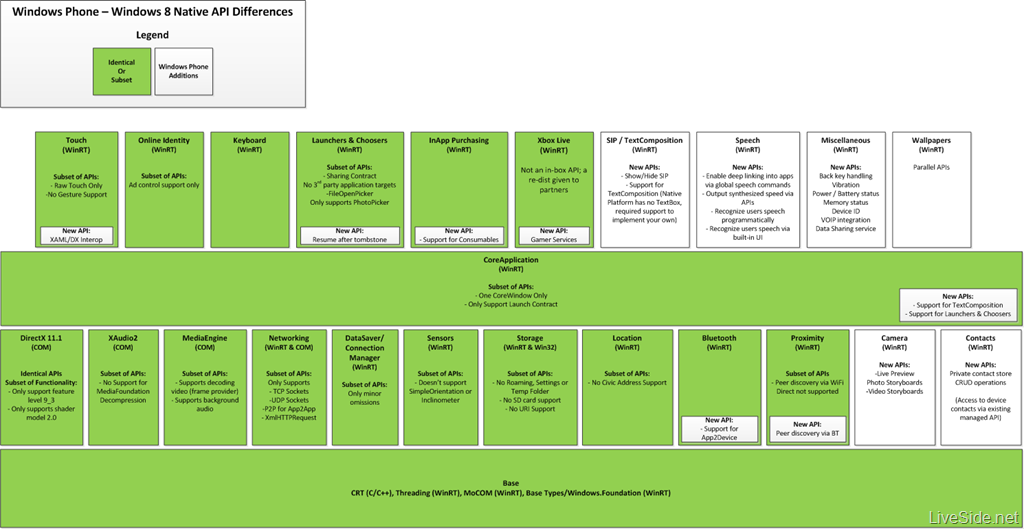
Most interesting -- to this architecture-diagram-obsessed reporter, at least -- is this programming-interface comparison chart, which LiveSide.Net discovered in the documents around the SDK.

This chart shows which of the application programming interfaces (APIs) are shared by the Windows Phone 8 OS, Windows 8 and Windows RT. There is some overlap, but there are also a number of APIs that are unique to the phone platform (indicated in white in the diagram).

Microsoft officials said last month that while Windows Phone 8 OS and Windows 8/Windows RT would share a "common core," the two platforms did not use or expose the identical set of APIs. In other words, it is not technically correct to say that Windows Phone 8 OS is "based on" the Windows RT framework, as I've seen a few sites claim. Microsoft is on a path to unify to the greatest extent possible the development tools and frameworks used by its Windows, Windows Phone and Xbox content developers.
(A related aside: Microsoft Research helped with some of the work involved in replacing the Windows Embedded Compact core in current Windows Phones and Windows Mobile phones with the Windows NT-based core. That effort was known as "Experiment 19.")
Some of my contacts have told me Microsoft's intention is to deliver to developers the official Windows Phone 8 SDK before the end of July, which gives them five more days if that information is correct. I've also heard Microsoft's goal is to release to manufacturing the Apollo Windows Phone 8 OS in September of this year, enabling Windows Phone 8 devices to hit the market by November 2012.

Wednesday, July 25, 2012

Apple unveils Safari 6: goes well with your new Mountain Lion (update: Windows version absent)

Apple unveils Safari 6 goes well with your new Mountain Lion
Apple's web browser has joined its latest OS, and joins the dots on a raft of new features that we've been promised for a while. These include iCloud tabs and a new tab view -- both Mountain Lion only -- alongside a new smart search and unified search (with support for Chinese search giant Baidu) and address bar. If your older OS is missing out on those iCloud tabs, there's some other good news, Reading Lists will now work without being online -- which all sounds very in-flight friendly. There's also a Do Not Track option to cover your internet tracks, but for all the minute detail on some new developer additions, we'd advise hitting the source below.
Update 1: We're not spotting a Windows release yet -- and nor can we see whether it will work on Snow Leopard. Let us know in the comments if you manage to grab the latest iteration. For anyone on Lion, the update will be available from the Mac App Store.
Update 2: The latest version may not arrive on Windows -- with all references to the old version now gone from Apple's site. As 9to5Mac notes, nightly WebKit builds are still out there if you have a sudden pang for Safari. We've reached out to Apple to confirm.

Twitter Is Working On A Tool To Let You Download All Of Your Old Tweets

Twitter is finally working on a solution to one of the most obvious things missing from the social network right now: the option for users to go back and find their tweets that are more than a few weeks or months old.
Twitter's CEO Dick Costolo told The New York Times that the social network is working on a tool to let users retrieve all of the updates they've posted to the social network.
“We’re working on a tool to let users export all of their tweets,” Costolo said. “You’ll be able to download a file of them.”
Some third-party services have come up with workaround solutions to this problem, including one new site called Oldtweets, which lets users search through all the tweets posted to Twitter in the first year after the social network launched.
Costolo wouldn't say when the tool might launch, noting that the tool isn't as simple as it sounds to make, and requires a good amount of manpower and ingenuity.

Samsung Galaxy S3 loses local search after 'stability' update

The latest update, earmarked to improve "stability," could in fact be considered a downgrade of the smartphone model.

Samsung is rolling out an update for its Galaxy S III smartphone that disables on-device search functionality.
According to Android Central, the over-the-air upgrade currently rolling out is described as a "stability" update and, although it brings system improvements, it also strips out the local search functionality from the device's inbuilt Google Search app.
Consequently, when S III owners conduct a web search on their smartphone, results generated from content stored locally on the device -- such as contacts -- will not be included.
Local search is reported to have been disabled on some U.S. S III devices, as well as on the unlocked international model.
The change is thought to be the result of the continuing patent spat between the South Korean company and Apple.
While Apple owns a patent that covers local searches, it has not been cited in the current legal battle. Samsung could well have just decided to go for the lesser of two evils -- limiting the functionality of the smartphone rather than face more legal wrangling over patents.

In This World, A Software Engineer Gets Paid More Than The CEO

VMware's $1.26 billion acquisition of tiny startup Nicira was as much about grabbing talent as grabbing  technology, Valley insiders say.
VMware has been the target of much raiding because the timing is right. The company went public about five years ago. Early employees have likely fully vested their shares.
So says Jedidiah Yueh, CEO of Menlo Park-based Delphix. (He has a history with VMware's majority share owner, EMC, who acquired his previous startup Avamar in 2006 for $165 million. He stayed at EMC for about a year.)
His current startup Delphix is now at 100 people, many of them from VMware, he says, including VMware's former vice president of product management, Karthik Rau.
"[Why did] VMware buy a company with under $10 million in revenue for over a billion dollars? It's a talent problem," says Yueh.
There is a major and "vicious recruiting" war going on in the Valley, says Big Switch cofounder Kyle Forster. Big Switch now has 44 employees and is hiring as fast is it can. But it hasn't been easy.
Forster says he turned down six of Cisco's distinguished engineers interested in working for him because they only knew hardware. A DE is the highest technical honor a Cisco employee can earn. When Forster found a DE that also knew VMware, not only did he hire the guy, but the company is "paying him more than we pay the CEO." (Big Switch's CEO is cofounder Guido Appenzeller.)
Meanwhile, Insieme, a Cisco-backed startup, has been raiding Nicira, VMware, and other companies for talent, too, and offering insane amounts of money—reportedly up to $2 million as an eventual payoff.
Why don't they hire from within Cisco? They do, but they are also in desperate need of software engineers. Insieme is run by an engineering team well-known to Cisco: Mario Mazzola, Prem Jain and Luca Cafiero. Cisco has backed them before with what's called a "spin-in" strategy, where Cisco has an option to buy the company but employees can earn startup-like paydays.
This team was responsible for Cisco's super successful server product, UCS, and its next-generation Nexus switches from a previous spin-in called Nuova Systems. But Nuova had a secret weapon: VMware cofounder Ed Bugnion. Bugnion was the guy that knew software, while the Mazzola, Jain, and Cafiero knew hardware. Bugnion left Cisco to get his PhD at Stanford about a year ago and a source close to him says he's got no plans to join Insieme.

Tuesday, July 24, 2012

Google Nexus 7 Display Fails on Bright Imagery

If you want a tablet with the best display, that’s not the Google Nexus 7, a display expert claims. The 7-inch tablet — which is garnering mainly positive reviews — may have difficulty showing all the detail in bright imagery, according to the Raymond Soneira at DisplayMate.
Soneira, the same display specialist who challenged Apple’s initial claims of a “retina” display on the iPhone 4, is now taking aim at Google‘s prize tablet. In his test of the Nexus 7 display, he found its resolution, viewing angle, contrast ratio and color all to be top-notch. However, when it came to grayscale, it fell far short.
Soneira discovered the Nexus 7 reduces the intensity of bright image content by up to 25% — meaning the brightest areas of an image are only about 75% as bright as they should be. That translates into some detail lost in the brightest areas of an image, and Soneira says the drop-off is “quite substantial.”
 Mashable did test of their own to see if they could see problem. Putting the Nexus 7 side-by-side with a comparably sized tablet, the Samsung Galaxy Tab 2, we looked at both a bright image and a grayscale test pattern, at maximum brightness.
On the image (this shot of a Typhoon Guchol posted by NASA’s Goddard Space Flight Center), they could see that some of the detail in the whitest areas was only visible on the Samsung, although the Nexus 7′s higher-resolution display — 1,280 x 800 to the Tab 2′s 1,024 x 600 — made things sharper overall.
The issue became clearer viewing this grayscale pattern. Looking at the strip of white and light-gray squares on the right side of the screen, the Nexus 7 makes them all look whiter than on the Galaxy Tab 2, with the 1% box appearing identical to 0%. You can see the issue in the photo below (100% brightness, Nexus 7 on the right). The problem persists even when the brightness on both tablets is turned down to 50%.

grayscale-test-100-640

How serious is this problem, though? They didn’t notice it at all when rhey reviewed the Nexus 7, and most reviews have been glowing about the tablet and its 7-inch IPS (in-plane switching) LCD screen.
“The Nexus 7 has a high quality display, they just really messed up the factory calibration,” Soneira told Mashable. “This affects all displayed images, but it is most noticeable on any form of photographic image, including videos. The analogy of an over exposed photo is a good one. For high-contrast text and graphics, the display will look fine.”
Although Google is the brand on the Nexus 7, Asus makes the tablet. Soneira suspects Asus as responsible for the issue, as the manufacturer is responsible for the problematic grayscale. A software update may be able to correct the problem.

Apple to present at Black Hat conference for first time, talk about iOS' padlocks

iPhone 4 rooted with Cydia

Apple is taking a different, more cautious tack when it comes to security these days. That doesn't make it any less surprising that the company is planning to give a presentation at the Black Hat conference: the company will have someone on stage for the first time and won't just socialize in the corridors. When he takes to the podium on July 26th, platform security manager Dallas De Atley will go into detail regarding iOS' security measures in front of an audience used to finding a way around them. The company hasn't said whether that involves current or future technology; we suspect that Apple may be eager to show what iOS 6 brings to the table, however. If it all goes down like Black Hat general manager Trey Ford says it will, Apple may both open up a bit on security and set more of the agenda this week -- instead of letting conference goers set it themselves.

Softwares to keep yourself safe on the Internet

Gone are the days when you had to stand in long queues to pay your electricity bills, phone bills, income tax returns and almost everything. But easy access to the internet and availability of these services online not just provide relief but of course helps in saving time. At the same time users are also exposed to the threats of identity theft, loss of personal information and spams.
If we follow a few golden rules we can easily protect our personal information and greatly reduce the possibility of fraud. Here are some of them:
Security suites 

Outpost Security Suite: This is the only free security suite that offers antivirus, firewall and anti-malware in a single package. It even offers email and web surfing security for online protection and monitors application behaviour to keep a check on malicious infections. Being free, it does have some limitations — only one auto update is allowed in a day. Others need to be manually done. Also, it does not include identity theft protection or technical support.
Norton 360 (v 6.0): As an all-in-one suite, Norton 360 (Rs 1,649) is pretty complete. Apart from protecting against local threats, it has a set of tools for online identity theft protection, to tune up your PC, Email and instant message monitoring as well as browser plugins to warn you of harmful websites & downloads. It even has parental controls to track Internet usage and keep kids safe from online threats. Finally, the price includes 2GB cloud storage. Norton 360 can automatically take a regular backup of important files to the cloud.
OFFICEETHICS: Computer network activity recording, monitoring, capturing software. Eliminates Computer Fraud, Cheating, Illegal Cyber Activities. Works 100 % confidentially & silently
  • Stops cybercrimes, frauds and cheatings in organization.
  • Stops and controls unwanted activities of employees.
  • Get snaps-photographs-text-voice-video of staff members’ activities.
  • Supports web. Check recorded activities of employees from anywhere, anytime.
  • Featured enriched, powered by latest technologies.
  • The most powerful solution ever developed to eliminate illegal cyber activities.
OFFICE ETHICS is computer activity monitoring software. This software records emails sent and received. Websites visited, conversation made in office. Programs run, network bandwidth used, files downloaded, all key pressed & mouse pressed. Porn websites visited, Social media sites visited like Facebook, Orkut, twitter and etc. Documents and letter opened, created, modified.
Internet used, web searches made, password entered, confidential files such as quotation, bills-purchase price list tempered/changed, files shared and transferred, folders and files copied/stolen on CD/pen drive, files and software’s downloaded, Video CDs/DVD watched. Instant messages sent, chat conversations made, IP address hacked, server hacked, websites & data hacked and all other major/minor activities made on computer system with exact date, time and username.
Office Ethics create monitoring reports in five different formats: Images, Text, Snapshots, Video and Voice. This software works 100 % confidentially and silently. Starts working at system boot in background and without informing people working on computers. No one will never come to know that OFFICE ETHICS is installed and watching and recording their activities every moment. Even computer experts or hackers or maintenance people cannot find threads of this software.
You can contact Office Ethics for 30 days demo version and proper installation instruction.

Nokia completes acquisiton of Scalado's imaging tech and developers


It's taken just over a month for Nokia to get everything in place, but its now announced that around 50 "world-class imaging specialists" have joined Espoo's already substantial mobile imaging department, alongside a stack of Scalado's technologies and intellectual property. The imaging specialist's co-founder, Sami Niemi, who will now head up the Capture and Relive section of Smart Devices at Nokia, said: "The technologies and competences we've developed should help move from taking photos to capturing memories and emotions." (We're sure those hulking PureView sensors will help too.) Take a look at Nokia's brief statement on its future in mobile imaging after the break.